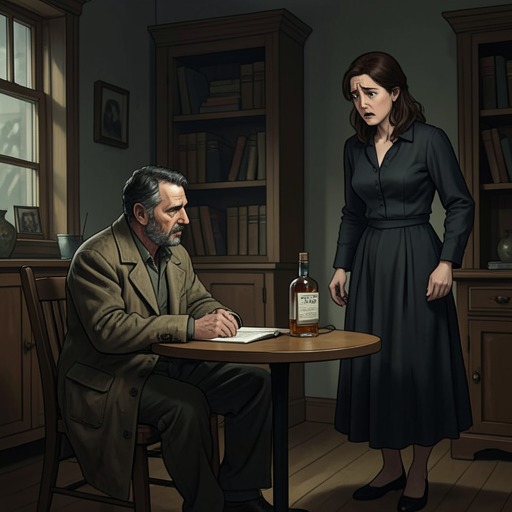
Lord Lowborough
The Tenant of Wildfell HallLord Lowborough is a tall, thin, gloomy-looking aristocrat whose sober manners initially distinguish him from the dissolute company around Arthur Huntingdon. His story turns on the gap between outward reserve and inward struggle: he can keep a solemn oath against gambling, yet repeatedly fails to free himself from an attachment to Annabella Wilmot, and later must confront her adultery. After that marriage ends, he chooses a second wife whom others judge by appearance but whom the narrative presents as an excellent mother and valued partner.
Identity and Introduction
When Lord Lowborough arrives at Wildfell Hall in a barouche, Gilbert Markham regards him as too sober and gentlemanly to fit the image of one of Arthur Huntingdon’s jolly, profligate companions. He is described as tall, thin, and gloomy-looking, apparently between thirty and forty. This first impression establishes the restraint that marks his public manner, though it does not reveal the instability of his private attachments.
His place in Arthur’s social circle exposes him to the group’s drinking and wild entertainments. He can be present among the company, hearing its songs and toasts, without being simply defined by its habits. The contrast between his reserved demeanor and the unruly social setting becomes central to his characterization.
Resolve, Relapse, and Social Company
Lord Lowborough’s attachment to Annabella is described as an infatuation that he does not willingly sustain. He is continually resolving to give it up and continually breaking those resolutions. His struggle is therefore not a single decision but a repeated cycle: intention promises release, while renewed attachment defeats the intention. Arthur Huntingdon notices how besotted he is and predicts that the match will leave him in difficulty once he has married Annabella.
His conduct around the men’s drinking culture is not reducible to unbroken abstinence. He joins the company’s mad toasts and wild songs, while a private bottle of laudanum is also known to be kept about him. These details qualify the initial impression of a wholly self-controlled man: his sobriety in manner coexists with exposure to destructive forms of excess and private means of escape.
Gambling, by contrast, supplies a concrete instance of resolve maintained. Lord Lowborough keeps his oath against it, to the surprise of those around him. The achievement matters precisely because the novel also shows how often he cannot keep his resolutions concerning Annabella. His self-command is real, but uneven: success in one struggle does not make him invulnerable in another.
Marriage and Betrayal
The marriage to Annabella places Lord Lowborough in the center of the novel’s conflict over fidelity. During the period when the household’s guests have arrived, he appears in scenes that reveal the social closeness of the group; later, his wife’s adultery becomes a personal catastrophe. Annabella’s conduct is not merely a private wrong between spouses: it brings the consequences of the surrounding circle’s conduct into his marriage and forces him to reckon with a betrayal that had been concealed from him.
When Lord Lowborough enters the room where Helen Huntingdon is present, his arrival is abrupt, and his manner changes as he recognizes her. He challenges her with the bitter accusation that she knew and had not told him. The confrontation shows how the revelation has altered his relation to Helen: he directs his anger not only at his wife’s betrayal but also at the possibility that another person knew the truth and withheld it. His accusation makes secrecy itself part of the injury.
Although the evidence does not make him a simple emblem of virtue, the episode sharpens the novel’s contrast between a husband’s declared self-restraint and the damage done by infidelity. Lord Lowborough is both a participant in the society that enables excess and a victim of its marital consequences. His experience gives the theme of adultery a cost beyond the immediate quarrel between Arthur Huntingdon and Helen Huntingdon.
Second Marriage and Later Life
After Annabella’s second misdemeanour, Lord Lowborough seeks a new marriage rather than remaining a bachelor. His choice is markedly different from his first. Some people wonder at his taste and even ridicule it, but the narrative rejects their judgment as foolish. The second wife is about his age, and her worth is established through her conduct: she becomes an excellent mother to the children and an invaluable wife to Lord Lowborough.
This later household offers a meaningful contrast with the first marriage. The account does not suggest that the earlier betrayal is erased; rather, it shows Lord Lowborough building a different domestic life after it. The qualities that sustain the second marriage are rendered through care and practical value, not through the infatuation that had made his first attachment so difficult to relinquish.
Narrative Role and Significance
Lord Lowborough’s arc brings together several forms of compromised self-command. His recurring surrender to infatuation contrasts with his successful oath against gambling; his sober public bearing sits beside his participation in drinking rituals and his private laudanum bottle. These differences make him more than a straightforward warning against vice: the novel presents moral resolve as specific and precarious, capable of holding in one area while failing in another.
His marriage plot also gives the novel’s criticism of sexual double standards a consequential counterpoint. Annabella’s adultery exposes Lord Lowborough to the damage that the men’s social circle often treats lightly when it concerns women’s security and reputation. His eventual second marriage, judged by the wife’s care for children and value as a partner, closes his story on a domestic arrangement unlike the first. The movement from repeated broken resolutions to a later, more successful household is a qualified change, not a claim that his earlier struggles never mattered.